

PBC Awareness
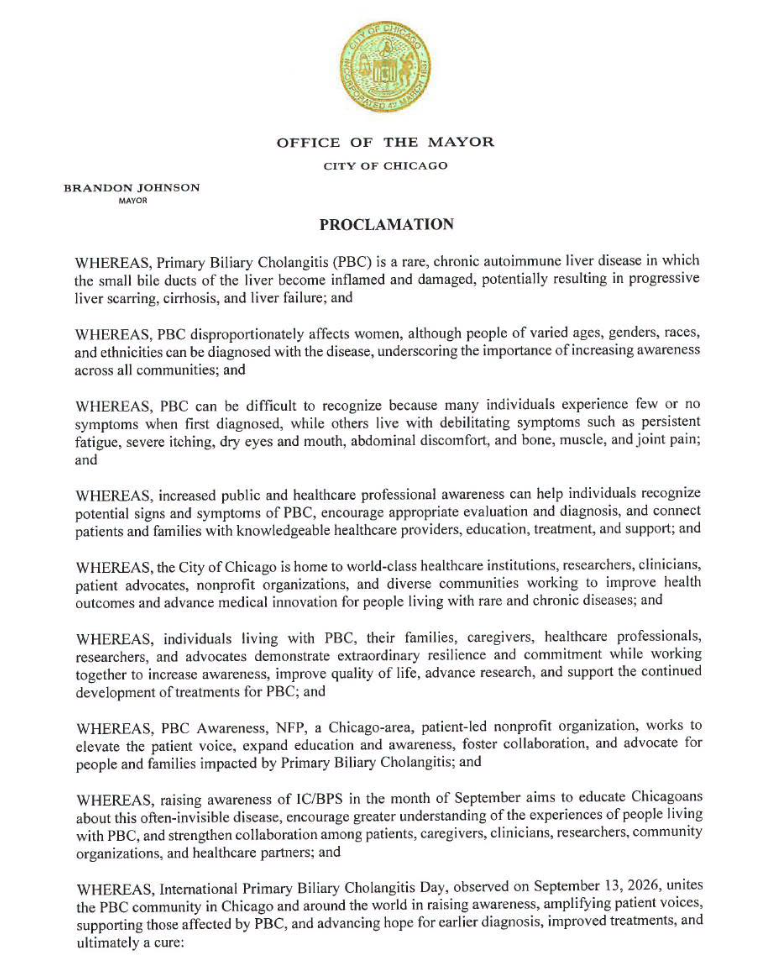
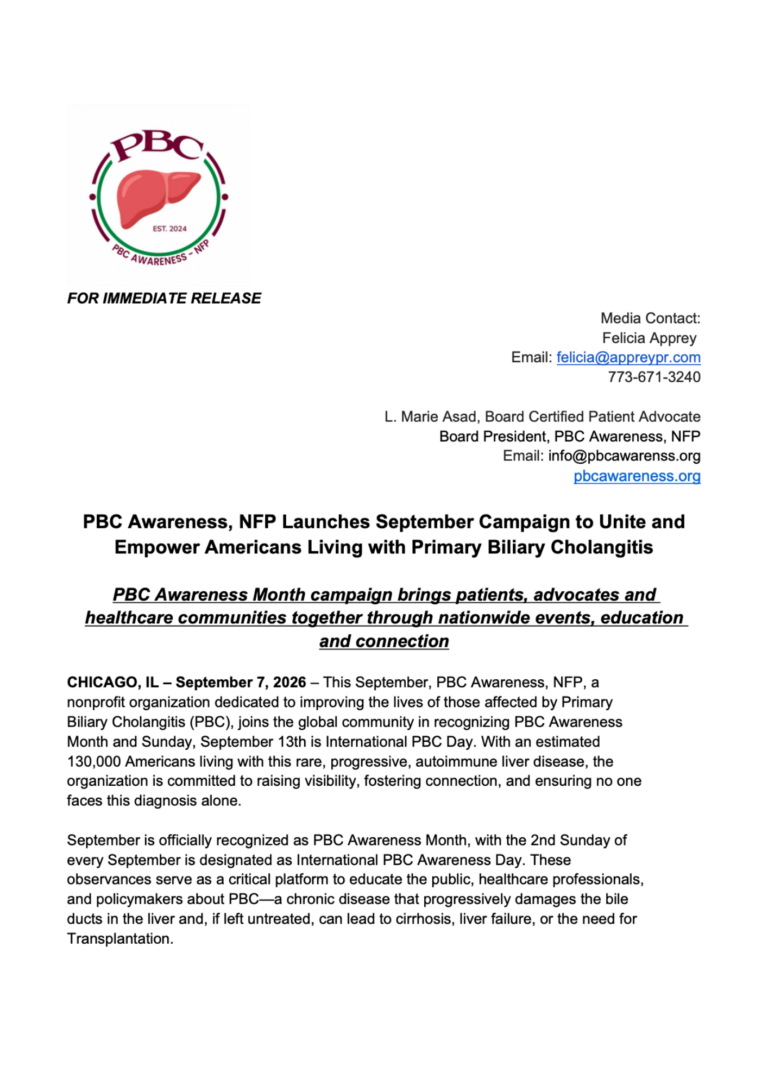
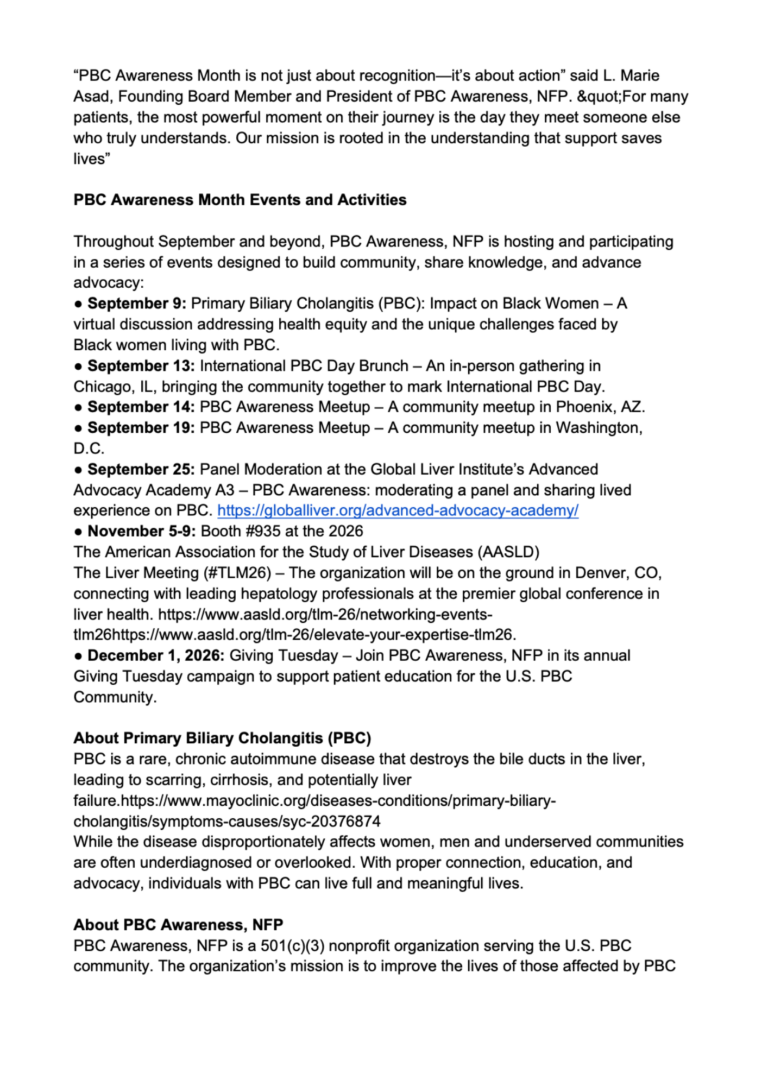
(opens in a new tab)PBC Awareness, NFP is an independent, founder-led and board-governed 501(c)3 dedicated to elevating patient voice, advancing education, and expanding national awareness of Primary Biliary Cholangitis (PBC)

Start a conversation with your doctor... That's the first step to self advocacy!
#PBCAwareness #PrimaryBiliaryCholangitis #pbcitch #pbcfatigueYou know your body best. Fatigue or itch can still affect people with primary biliary cholangitis (PBC) even if labs are well managed.
Talk with a doctor about symptoms. This discussion guide can help you get started: bit.ly/4h7iaxB. #PrimaryBiliaryCholangitis

THE 1-YEAR MARK: WHY YOUR PBC BLOODWORK MATTERS SO MUCH
When you're taking ursodeoxycholic acid (UDCA) — the standard first-line treatment for PBC — your doctor likely checks your bloodwork regularly. But a new study presented at AASLD 2026 shows just how important that 12-month check-in really is.
Here's the simple version:
Researchers looked at real-world data from nearly 3,000 PBC patients to see if responding well to UDCA at 1 year made a difference in long-term health. They found that it absolutely does.
What they found:
*Patients who responded well to UDCA at 12 months (defined as ALP ≤130 U/L and bilirubin ≤1.0 mg/dL) had a lower 5-year risk of serious liver complications (10.2% vs. 17.8% for non-responders).
*They also had a lower risk of death over 5 years (12.2% vs. 16.3%).
*Non-responders were much more likely to need second-line therapy.
Why this matters for you:
The lead researcher emphasized that response predicts outcomes in real-world care — and that "nonresponders carry a risk." The key takeaway? If you're not responding to UDCA by the 1-year mark, it may be time to talk to your doctor about escalating treatment without delay.
While UDCA works well for many, about 20% to 40% of patients don't respond biochemically at 12 months. That's why monitoring your ALP and bilirubin at that 1-year mark is so important.
👉🏾 Do you know your 12-month lab numbers? If not, add it to your list of questions for your next appointment.
#PBCAwareness #PrimaryBiliaryCholangitis #PBCResearch #LiverHealth #AASLD2026

Response to Standard PBC Treatment at 1 Year Linked to Lower Long-Term Risks
www.medpagetoday.com
'Response predicts outcomes in real-world care, and nonresponders carry a risk,' researcher says
That itch with PBC? You don't have to just live with it!
Swipe through to learn:
🔹 What PBC itch really is
🔹 Why your labs don't tell the whole story
🔹 The difference between treating PBC and treating the itch
🔹 New FDA-approved options (including Lynavoy)
🔹 Other treatments your doctor may try
🔹 What to do next
You deserve relief. Keep advocating for yourself!
Save this. Share it. Bring it to your next appointment.
#PBCItch #PrimaryBiliaryCholangitis #PBCAwareness #LiverDisease #RareDisease #ChronicIllness #PatientAdvocacy #ItchRelief
Learn more here.....
primarybiliarycholangitis.net/living/itch-treatment

Tune in for the virtual viewing experience of Beyond Tired and continue the conversation around the impact of PBC-related fatigue. Everyone is welcome—people with PBC, loved ones, healthcare providers, you name it!
Click the link below to view the trailer!
youtu.be/eRP6cjYIw40?si=Yilg5E5hvr0abWNr
#PBCAwareness #PrimaryBiliaryCholangitis #

NEW RESEARCH: A STEP CLOSER TO NORMAL LIVER NUMBERS FOR MORE PBC PATIENTS
If you live with PBC, you probably know about ALP (alkaline phosphatase) — a key marker doctors look at to see how active the disease is. For many patients, getting ALP back into the normal range has been a challenge.
But new results from the phase 3 ELSPIRE trial are offering real hope.
Researchers looked at patients whose ALP was still elevated despite taking the standard first-line medication (UDCA). They tested adding elafibranor to their treatment.
The results were striking:
✅ 85.3% of patients taking elafibranor achieved normal ALP levels, compared to only 23.3% on placebo.
📉 ALP dropped by an average of 36.5% in the elafibranor group, with improvements seen as early as 4 weeks.
🛡️ Safety was generally consistent with earlier studies — no new safety concerns emerged. Weight gain of more than 5% was more common with elafibranor (22.6% vs. 6.7%).
Why does this matter?
For years, the goal was just to lower ALP to an "acceptable" level. But a growing body of evidence suggests that getting ALP back to normal may be linked to better long-term liver outcomes. As one of the study authors put it, these results support the idea that "earlier treatment with a second-line drug like elafibranor" may be worth discussing with your care team.
Important context: This study included mostly White participants, and more research is ongoing to confirm long-term outcomes. But for many patients, these numbers represent real hope. This is a reminder that it is necessary for patients of color to participate in these studies so scientists will understand the efficacy of drugs on every patient.
👉🏾 If you're on UDCA and your numbers are still elevated, what questions do you have for your doctor? Share below. (Doctors take note!)
#PBCAwareness #PrimaryBiliaryCholangitis #PBCResearch #LiverHealthMatters

Elafibranor Added to UDCA Normalizes ALP in PBC
www.medscape.com
Adding elafibranor to UDCA normalizes alkaline phosphatase in 85% of patients with PBC, results of the phase 3 ELSPIRE trial show.